
- Breaking
Supreme Court of Canada to Hear Ontario's International iGaming Liquidity Appeal on 7 October
The Supreme Court of Canada is scheduled to hear on 7 October whether Ontario could link its regulated online gaming to players outside Canada without breaching the Criminal Code. No judgment has been issued.

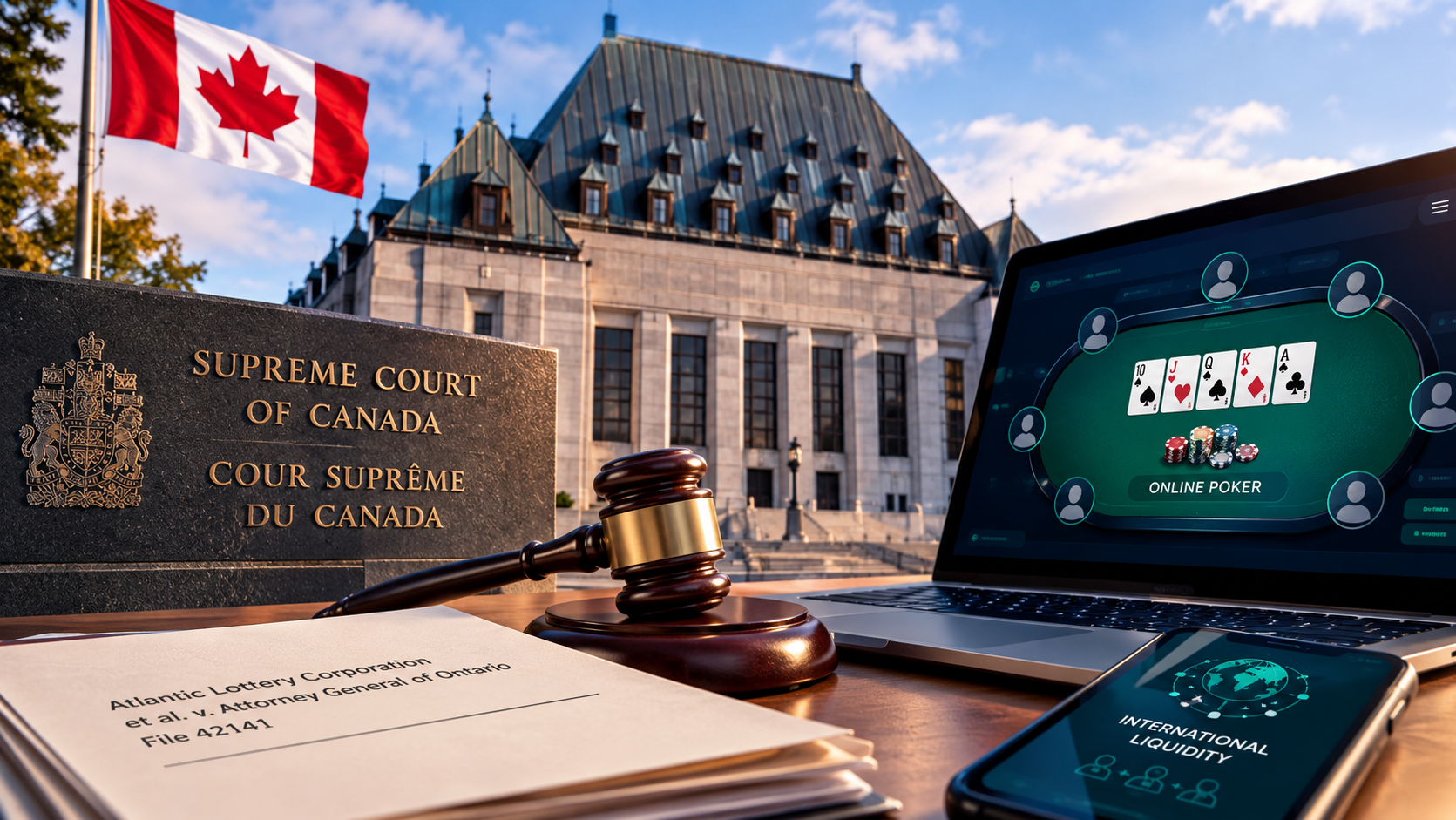
The Supreme Court of Canada is scheduled to hear an appeal on 7 October 2026 over whether Ontario could allow players on its regulated online gaming sites to take part in games and betting involving people outside Canada without breaching the Criminal Code. The hearing is an oral argument. No judgment has been issued, and the Court has not announced when it will rule, according to the materials reviewed.
The appeal, Atlantic Lottery Corporation, et al. v. Attorney General of Ontario (file 42141), was brought as of right after the Court of Appeal for Ontario answered Ontario's reference question in the province's favour on 12 November 2025. The appellants are Atlantic Lottery Corporation, the British Columbia Lottery Corporation and Manitoba Liquor and Lotteries Corporation. Trade reporting says Loto-Québec was added as an appellant on 2 April 2026. The Attorney General of Ontario is the respondent.
What the Court is being asked
The case grows out of Order in Council 210/2024, under which Ontario's Lieutenant Governor in Council referred two questions to the Court of Appeal on 2 February 2024. The first asked whether legal online gaming and sports betting would remain lawful under the Criminal Code if users could take part in games and betting involving individuals outside Canada, as described in a schedule to the order. That arrangement is referred to as the Proposed Model. The second question, "If not, to what extent?", went unanswered because the Court of Appeal majority answered the first in the affirmative.
Both courts are dealing with a question of statutory interpretation. Section 207(1)(a) of the Criminal Code makes it lawful for the government of a province to conduct and manage a lottery scheme "in that province". The dispute is over what that phrase allows when a provincially run scheme is linked to players abroad.
Law-firm analysis of the Court of Appeal decision says the model would keep players in the rest of Canada out unless Ontario reached agreements with other provinces, and that Ontario would continue to conduct and manage its side through iGaming Ontario and its operator agents. Legal and trade commentary describes the practical focus as peer-to-peer products such as online poker and daily fantasy sports. Ontario's current regulated market keeps players in Ontario-only pools.
The Court of Appeal decision
In Reference re iGaming Ontario, 2025 ONCA 770, a majority of the five-judge panel held that the Proposed Model would remain lawful under section 207(1)(a). Law-firm summaries say the majority read "in that province" broadly, reasoning that Parliament had not prohibited linking a provincial scheme to foreign ones and that the provision's purpose was to replace federal criminalisation with provincial regulation. The split was four to one, according to Torys.
Justice van Rensburg dissented. She would have answered the first question in the negative and found that Ontario's involvement in the international aspects of the model would contravene the Criminal Code's gaming prohibitions, with the section 207(1)(a) exemption not applying, according to the Supreme Court's case summary.
The arguments
The lottery corporations argue that the majority sidestepped the Supreme Court's 2003 decision in Reference re Earth Future Lottery, in which, they say, the same words required a scheme to be conducted and managed within the province's geographic boundaries. They also argue that Ontario's plan would involve collaboration with international operators, many of which they say operate illegally in the rest of Canada, according to their written argument as reported.
Ontario's written argument, as reported, frames the model as a player-protection measure: offering international play through iGaming Ontario's regulated platform would draw people away from unlawful sites, and the territorial limit in section 207(1)(a) applies within Canada rather than abroad.
The interveners listed in trade reports include Flutter Entertainment plc, NSUS Group Inc. and NSUS Limited, the Canadian Gaming Association and the Attorney General of Alberta, and those reports say they hope the Court of Appeal's conclusion is upheld. Alberta, which runs its own commercial iGaming market, told the Court that the interpretation of whether iGaming Ontario remains lawful could affect the validity and operation of Alberta's online gaming statute, according to Canadian Gaming Business.
What happens next
The Supreme Court's decision will not change anything for operators or players on the day of the hearing. If the Court of Appeal's opinion stands, Ontario would still need a regulatory framework and agreements with foreign jurisdictions before any operator could pool players internationally, according to law-firm analysis and trade reports. Until then, regulated play in Ontario continues in Ontario-only player pools.
The Court has not published a judgment date. This article will need updating once the hearing has taken place and when the Court rules.
Sources
- Atlantic Lottery Corporation, et al. v. Attorney General of Ontario, case 42141
Court's public case file: parties, reference questions, registrar's summary of the Court of Appeal majority and dissent, and lower-court ruling details. - Game on: Court of Appeal greenlights cross-border betting and gaming for Ontario players
Law-firm analysis of Reference re iGaming Ontario, 2025 ONCA 770: the majority and dissenting reasoning and implementation points. - Supreme Court of Canada to consider legality of legal online gaming and sports betting
Trade report of the 7 October hearing date, the appellants, and Loto-Québec's addition on 2 April 2026. - Ontario Poker Liquidity Fight Reaches Supreme Court of Canada Oct. 7
Trade report summarising the parties' written arguments, interveners and the model's next steps, citing the Court's case file. - Ontario and Alberta to argue for cross-border iGaming play in Supreme Court hearing
Trade report on Alberta's reasons for intervening and the interveners' positions.
Reporting & Methodology
This article draws on the Supreme Court of Canada's public case file for 42141 (registrar's summary, parties and lower-court details), law-firm analysis of the Court of Appeal for Ontario decision, and trade-press reports of the parties' written arguments and the hearing date. The Court of Appeal's reasons and the parties' filed arguments could not be opened directly and are described through those secondary sources.